Three of them run by Lao government agronomists, one under full statistical control. Every trial is a page here with the method, the rate, the control and what was measured — not a download link.
Plantains into previously infected soil, against a registered fungicide programme. Treated rows carrying full bunches with no symptoms at 40 months; all control plants affected.
Yield rose with rate across all three treated lots — 45%, 56% and 69% against the untreated control. Grade A quality. A 2021 follow-up found the effect still running three years on with no further application.
Half the usual water available. Treated lots up 30% on the prior year with no fertiliser at all; control lots, on three NPK applications, down 20%.
Four rates on cleared, verified TR1-affected ground. Nine months of height and circumference data collected by government agronomists. Every plant in the untreated control died; treated lots showed no TR1.
The most commercially significant trial. TR4 appeared on every treated lot. The difference was in degree — and in the control all plants died.
One combined study covering both crops. Four treatments, four replications, 16 units, statistically analysed at 95% confidence by the Lao Plant Protection Centre. Differences significant on leaf number, height, leaf length and width, stem circumference, cob length and cob weight.
Grower endorsements. Six Queensland growers on citrus, custard apple, taro, native fruit and bananas, with the block, the rate and what they saw.
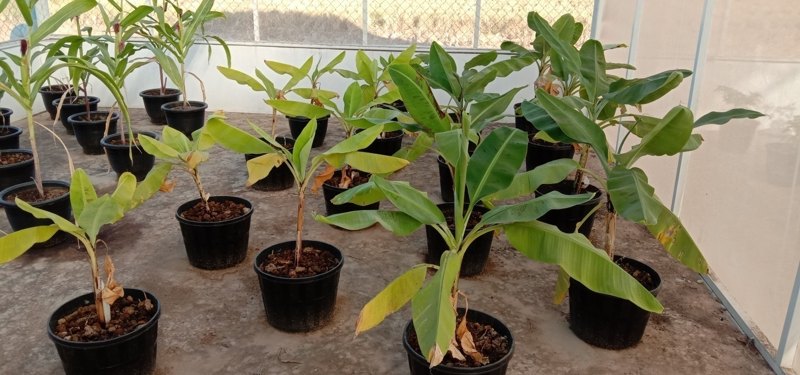
These are field observations of crop health and yield where The Black Stuff was applied.
Across nine years, two countries and eight trials, the rate that keeps coming back is 3 m³/ha. Higher rates did better in the rice work; below 3, less impact is observed.
The second constant is time. Nothing here happened overnight. The rice trial ran a season, the Queensland plantain trial ran forty months, and the follow-up on the 2019 rice found the effect still working three years after a single application.
That is the case for The Black Stuff: it has persistency that lasts over seasons.
| Trial | Rate found best |
|---|---|
| Wet season rice, Lao 2019 | 0.142 L/m² — highest of three |
| Dry season rice, Lao 2020 | 3 t/ha |
| Sugar banana TR1, Lao 2020 | 3 t/ha |
| Cavendish TR4, Lao 2020 | 3 t/ha + split NPK |
| PPC banana & maize, 2019–20 | 3 t/ha |
| Plantains, East Palmerston 2021 | 3 m³/ha |
Tonnes and cubic metres are close to interchangeable at this material's density — roughly 1.05–1.10 t/m³ in the ground. As The Black Stuff dries the rate may drop to 0.8–0.9 t/m³. There is no effect on its efficacy.
