If yours is not here, ring 1300 082 011.
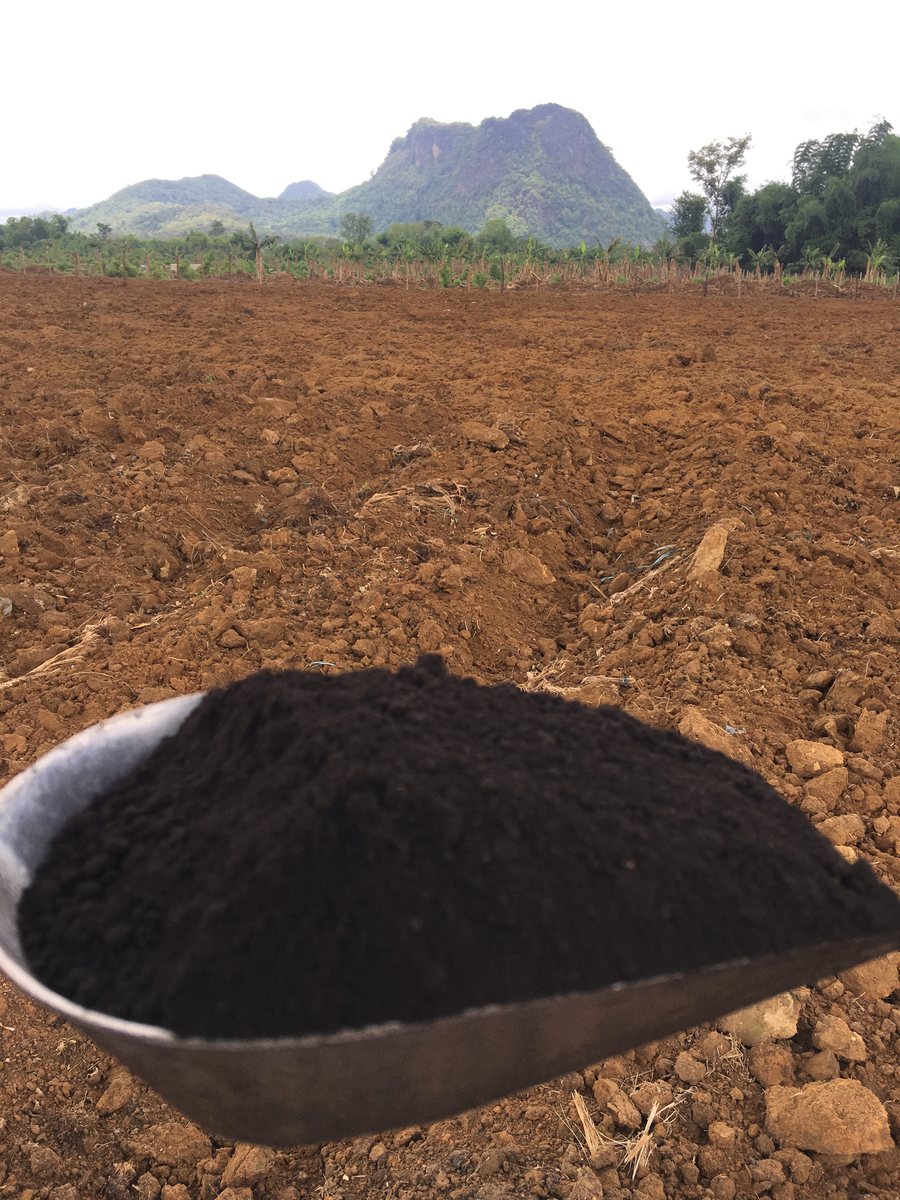
A humate — vegetative matter that decomposed under anaerobic conditions, usually beneath standing water. The Black Stuff formed in a volcanic maar on the Atherton Tablelands over tens of thousands of years, in circumstances that concentrated the humic and fulvic acids and left them available. No chemical processing is needed to activate it.
No. It is a soil conditioner. It improves soil health and supports beneficial soil biology. A strong cation balance means it holds water and fertiliser in the root zone, so plants take up nutrients more readily and you need less of both.
In trials it has been found still present and active more than five years after application. It has persisted in the ground for tens of thousands of years. It is depleted by physical removal — washed off in a storm, blown away if dried out — not by breaking down. Top-up depends on soil type, rainfall, irrigation, chemical use, topography and crop. Manufactured humates, by contrast, are formulated to be soluble and applied through fertigation; frequent reapplication is needed.
Bags are $900 + GST per bag, ex factory, with no minimum order. Over 3 bags, ask us for a quote. Loose bulk is $700 + GST per m³ from 20 m³. A 10 L pail for the garden is $29.95, plus $24.95 postage anywhere in Australia, or free if you collect from Glen Allyn. Buy a pail.
3–5 m³/ha for horticulture, fruit, nuts and vines. Start at 3 for broadacre. 0.3 litres per m² for garden beds; 0.5–1 litre per pot; 15% by volume in a seedling mix. These are starting points — adjust with local agronomic advice and a soil test.
Four steps. Spread it — break up clumps first, side-throw or auger spreaders work best, never onto the plants. Cover it straight away with mulch or soil, or incorporate it. Water it in well to rehydrate and activate it. Then record the batch number, rate, area and date, and leave an untreated strip to compare against. Full detail is on the how to apply page.
Should the product dry out it can be dusty. Wear a P2 face mask, sealed goggles and gloves, with long sleeves. Work upwind of the spreader and spread in low wind — early morning is best. The product is acidic at about pH 4.5, so wash hands and face afterwards and flush eyes with clean water. Follow the safety directions on the pack.
Keep it covered until you use it — tarped, shedded, or with the bag spouts closed. It handles heat, cold and being soaked, and stays active, so there is no shelf-life problem. If it has dried out it will shed water at first; rehydrate with repeated light waterings rather than one heavy one.
Section A material averages 11.3% humic acid on IHSS fractionation, rising to 32.3% in the premium horizon. Fulvic acid runs to 4.8%. Always check the method beside any humic acid figure — the California CDFA method reports higher numbers than IHSS, so the two cannot be compared directly. Ours are IHSS. Full ranges are on the specification page.
It is a natural product with no additives, so colour and texture vary between batches. Recalibrate the spreader and carry on.
Most are made from leonardite — oxidised brown coal from Northern Hemisphere lignite seams in the United States, Germany, India and China, or brown coal from Victoria's Latrobe Valley. It is ground to a dust and treated with strong alkali to strip out the humic acids, producing a concentrated, highly soluble potassium humate. Being soluble is the point for fertigation, and also the problem: it moves through the profile, it can precipitate and block micro-irrigation systems, and it needs reapplying. The Black Stuff is not leonardite and is not coal-derived — it is biogenic peat, sourced, screened and blended, nothing added.
Expected. It works on the soil, not the leaf. Judge it over seasons against the untreated strip you left.
